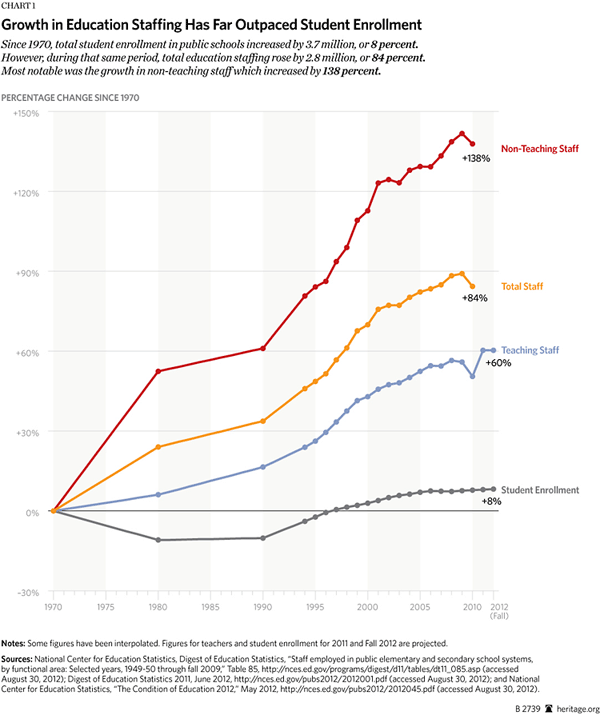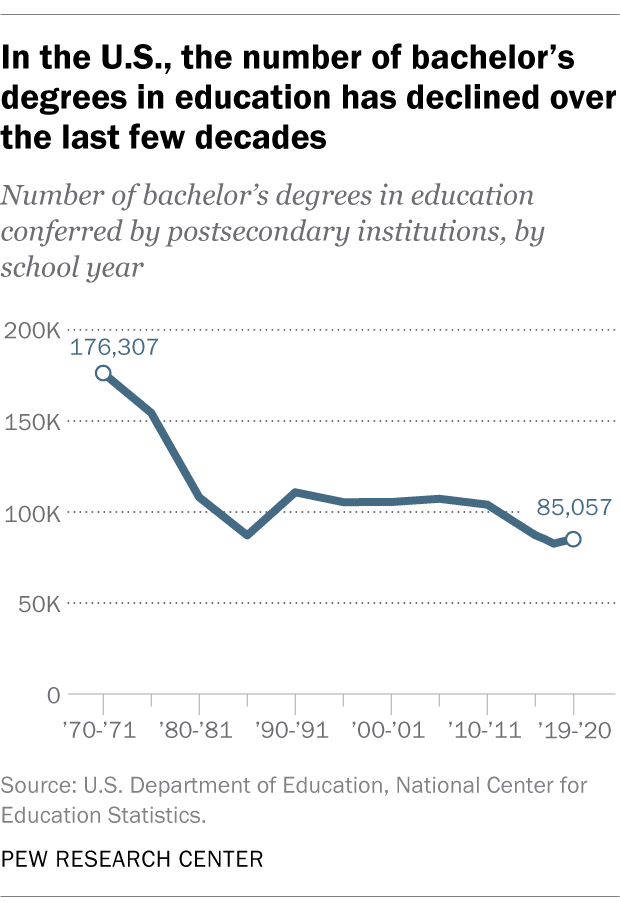
Common Core and NCLB are two big ones moving the job from educating to testing, but the shift to politicized curriculum and teaching as social justice advocacy have also been huge in altering the perception of what public school teachers do and alienating a substantial amount of people from the profession, particularly in places like rural red states. SEL and Restorative Justice in place of punishment have made schools violent and dangerous for staff. The administrative bloat in most systems is also sapping resources that should be going to teachers and classrooms.McParadigm wrote:
I don’t know what changes to the status quo you are referring to that caused a teacher shortage. I know that in 1998 when people would ask what I was going to school to become and I would say “teacher,” the most common first reaction was “well you shouldn’t have trouble finding work, with the coming shortage.” The combination of workforce aging and not enough new people coming in was a national news conversation back then…a decade before a 30% reduction in profession intake began. You may recall that the easing of teacher licensing in order to address the shortage was a central component of George W Bush’s education policy, his first year in office.Seems like all those slight changes in the status-quo over the years are adding up to a big problem.
How damage has Randi Weingarten alone done to the common perception of teachers and teaching?
McParadigm wrote:I’m going to skip past the question of “How would decreasing stress, eliminating staff shortage-sourced overwork, and increasing the amount of in-office time teachers have to grade papers and plan lessons help us retain more teachers,” and instead, reemphasize the logistical reality that a shortage factually is. If you don’t currently have enough people to fully staff a five day school week and you are also facing drastic recruiting AND retention problems, there isn’t a world where you just get to keep going as is. Either those problems are addressed, or you have to start looking at reductions of services.So how does the 4 day week, particularly when you are still bringing the kids to the building and someone is still being paid to supervise them and teachers are still working, address this?
Remember last year when everyone was talking about a 10% drop in police applicants? Talking about how if it didn’t reverse, police services would necessarily have to be reduced? That was a 10% drop. Ohio is facing a 50% decline in applicants. If there’s an ideological model that is tearing apart these systems, it is the rejection of taxation policies that would allow us to pay cops and teachers what they’re worth.
The evidence does not point to the 4 day week improving teacher retention:
https://www.edweek.org/leadership/what- ... ek/2023/02
Impact on students and teachers
The researchers found a statistically significant decline in students’ performance on math and English standardized tests in the years following the transition to a four-day week.
That decrease is likely attributable to the schedule switch, the report says, because there weren’t notable changes in student demographics, and other nearby districts didn’t experience comparable drops.
It’s not clear if any subgroups of students performed better academically after the switch, Perrone said, because researchers only had access to aggregate grade-level data.
The change also didn’t help the district keep teachers in their jobs, even though some districts with four-day weeks have pointed to the schedule as a perk.
The report estimates that switching to a four-day school week decreased the probability that teachers would return the next year by 3 percentage points.
And the impact was greater on mid-career teachers—those with five to 15 years of experience—who were 5 percentage points less likely to return to the district.
I agree that it's a death spiral, but it seems like less classroom time makes it worse and you'll end with babysitters not teachers.