Our universe is so rad!
-
dimejinky99

- what on earth am I talking about
- Posts: 39789
- Joined: Wed January 02, 2013 12:35 am
-
nyquillyn
- Misplaced My Sponge
- Posts: 5825
- Joined: Tue January 01, 2013 2:11 pm
Re: Our universe is so rad!
Basically sub-atomic information, I believe. Particles, bonds, etc.
-
E.H. Ruddock

- Guys, I am not a moderator! I swear to God! Why does everyone think I'm a moderator?
- Posts: 52161
- Joined: Tue January 01, 2013 2:48 pm
Re: Our universe is so rad!
The B-side to Of the Earthdimejinky99 wrote:what is quantum information?
Clouuuuds Rolll byyy...BANG BANG BANG BANG
-
dimejinky99
- what on earth am I talking about
- Posts: 39789
- Joined: Wed January 02, 2013 12:35 am

-
nyquillyn
- Misplaced My Sponge
- Posts: 5825
- Joined: Tue January 01, 2013 2:11 pm
Re: Our universe is so rad!
This is cool.
Vast ocean lays under Earth mantle, may be wellspring for world's oceans
A reservoir of water lying deep under the Earth's surface may contain triple the volume of every one the world's oceans and may even be the "wellspring" source of them, U.S. researchers say.
Although not in a liquid form most familiar to all of us -- it is instead bound within rocks deep in the Earth's mantle -- it likely represents the largest reservoir of water on Earth, scientists at the University of New Mexico and Northwestern University say.
Writing in the journal Science, they report finding pockets of melted magma 400 miles underneath the North American continent that are likely signatures that water exists at those depths.
Scientists have long questioned whether the mantle, the rocky, hot layer between the Earth's crust and its core, might contain water bound up and trapped within rare minerals.
The new discovery is evidence water can be transported from the surface of the Earth to great depth by plate tectonics, the movement of continents and plates over the Earth's surface.
"Geological processes on the Earth's surface, such as earthquakes or erupting volcanoes, are an expression of what is going on inside the Earth, out of our sight," says geophysicist and study co-author Steve Jacobsen at Northwestern. "I think we are finally seeing evidence for a whole-Earth water cycle, which may help explain the vast amount of liquid water on the surface of our habitable planet."
Movement and partial melting of rocks in the mantle's transition zone -- a region between the mantle's lower and upper layers from around 250 to 400 miles deep -- could allow water to become tightly bound into the minerals there, the researchers said.
To test if the transition zone could be a possible deep water reservoir, the researchers used seismic waves recorded during earthquakes to analyze the structure of the mantle in the zone and to detect if melting is taking place as tectonics drives rocks ever deeper.
"If we are seeing this melting, then there has to be this water in the transition zone," University of New Mexico seismologist Brandon Schmandt says.
"Melting is just a mechanism of getting rid of the water," he says.
If the surface water the Earth possesses today came from such degassing of molten rock, the researchers say, that's in contrast to the theory held by some scientists that water came to a young Earth by way of large, icy comets.
It is of course the existence of liquid water on the surface of the Earth that makes our planet habitable and capable of supporting life, which is why its origin is of such interest to science.
The latest findings are strong evidence of a process where water has long been cycling between deep interior reservoirs and the surface through the action of plate tectonics, the researchers say.
"Scientists have been looking for this missing deep water for decades," Jacobsen says.
And may just have found it.
http://www.techtimes.com/articles/8474/ ... o-knew.htm
Vast ocean lays under Earth mantle, may be wellspring for world's oceans
A reservoir of water lying deep under the Earth's surface may contain triple the volume of every one the world's oceans and may even be the "wellspring" source of them, U.S. researchers say.
Although not in a liquid form most familiar to all of us -- it is instead bound within rocks deep in the Earth's mantle -- it likely represents the largest reservoir of water on Earth, scientists at the University of New Mexico and Northwestern University say.
Writing in the journal Science, they report finding pockets of melted magma 400 miles underneath the North American continent that are likely signatures that water exists at those depths.
Scientists have long questioned whether the mantle, the rocky, hot layer between the Earth's crust and its core, might contain water bound up and trapped within rare minerals.
The new discovery is evidence water can be transported from the surface of the Earth to great depth by plate tectonics, the movement of continents and plates over the Earth's surface.
"Geological processes on the Earth's surface, such as earthquakes or erupting volcanoes, are an expression of what is going on inside the Earth, out of our sight," says geophysicist and study co-author Steve Jacobsen at Northwestern. "I think we are finally seeing evidence for a whole-Earth water cycle, which may help explain the vast amount of liquid water on the surface of our habitable planet."
Movement and partial melting of rocks in the mantle's transition zone -- a region between the mantle's lower and upper layers from around 250 to 400 miles deep -- could allow water to become tightly bound into the minerals there, the researchers said.
To test if the transition zone could be a possible deep water reservoir, the researchers used seismic waves recorded during earthquakes to analyze the structure of the mantle in the zone and to detect if melting is taking place as tectonics drives rocks ever deeper.
"If we are seeing this melting, then there has to be this water in the transition zone," University of New Mexico seismologist Brandon Schmandt says.
"Melting is just a mechanism of getting rid of the water," he says.
If the surface water the Earth possesses today came from such degassing of molten rock, the researchers say, that's in contrast to the theory held by some scientists that water came to a young Earth by way of large, icy comets.
It is of course the existence of liquid water on the surface of the Earth that makes our planet habitable and capable of supporting life, which is why its origin is of such interest to science.
The latest findings are strong evidence of a process where water has long been cycling between deep interior reservoirs and the surface through the action of plate tectonics, the researchers say.
"Scientists have been looking for this missing deep water for decades," Jacobsen says.
And may just have found it.
http://www.techtimes.com/articles/8474/ ... o-knew.htm
-
Norah

- Poster of the Year
- Posts: 37606
- Joined: Tue January 01, 2013 2:04 pm
- Location: September 2020 Poster of the Month
Re: Our universe is so rad!
that is cool
-
Kaius
- I've been POOSSTTIiiEEnngeeaahh
- Posts: 11136
- Joined: Fri November 15, 2013 6:14 am
Re: Our universe is so rad!
It actually sounds extremely hot, chud
Melting rocks and whatnot
Melting rocks and whatnot
-
Norah
- Poster of the Year
- Posts: 37606
- Joined: Tue January 01, 2013 2:04 pm
- Location: September 2020 Poster of the Month
Re: Our universe is so rad!
it's getting steamy in here
-
Kaius
- I've been POOSSTTIiiEEnngeeaahh
- Posts: 11136
- Joined: Fri November 15, 2013 6:14 am

-
nyquillyn
- Misplaced My Sponge
- Posts: 5825
- Joined: Tue January 01, 2013 2:11 pm
Re: Our universe is so rad!
What that article doesn't really mention and the most interesting question this raises is the possibility that life actually started subterranean. Instead of just crawling out of the sea, maybe we found our way out of Earth's crust first and then crawled out of the sea.
-
nyquillyn
- Misplaced My Sponge
- Posts: 5825
- Joined: Tue January 01, 2013 2:11 pm
Re: Our universe is so rad!
NASA Mission Captures Video of Massive Solar Fireworks
-
nyquillyn
- Misplaced My Sponge
- Posts: 5825
- Joined: Tue January 01, 2013 2:11 pm
Re: Our universe is so rad!
'Extreme solar storm' could have pulled the plug on Earth
Satellites, power and water supplies would have been hit if billion-ton plasma cloud had erupted from sun a week earlier
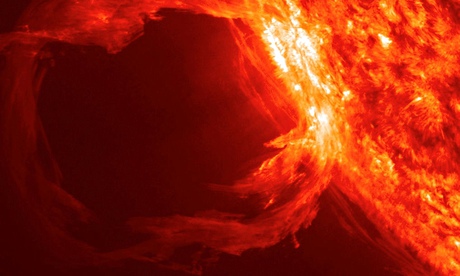
The date of 23 July 2012 could have been the day the lights went out, along with suddenly not-so-smart phones, computers, satellite transmissions, GPS navigation systems, televisions, radio broadcasts, hospital equipment, electric pumps and water supplies.
On that day an "extreme solar storm" did its best to end life on Earth as we know it. The sun forced out one of the biggest plasma clouds ever detected at a speed of 3,000km per second, more than four times faster than a typical solar eruption. Fortunately it missed.
"If it had hit, we would still be picking up the pieces," said Daniel Baker, of the Laboratory for Atmospheric and Space Physics at the University of Colorado. "I have come away from our recent studies more convinced than ever that Earth and its inhabitants were incredibly fortunate that the 2012 eruption happened when it did. If the eruption had occurred only one week earlier, Earth would have been in the line of fire."
With colleagues from Nasa and other universities, Baker has been studying the disaster that wasn't. If the coronal mass ejection (CME) had hit the Earth, it would have disabled "everything that plugs into a wall socket".
There would have been major disruption to all satellite communications and electrical fluctuations that could have blown out transformers in power grids. Most people wouldn't have been able to turn on a tap or flush a toilet because urban water supplies largely rely on electricity.
Nasa has calculated that the cost would have been 20 times the devastation caused by hurricane Katrina, at $2tn.
The storm would have begun with a solar flare, which itself can cause radio blackouts and GPS navigation failures. If the Earth had been in its path, this would have been followed minutes to hours later by the electrons and protons accelerated by the blast, followed by the CME, a billion-ton cloud of magnetized plasma.
There is a lavish amount of data on the storm for Baker and the other scientists to study because, although the plasma cloud missed the Earth, it hit a spacecraft loaded with monitoring equipment.
The solar storm was described as a "Carrington Event" after the solar storm witnessed by the English astronomer Richard Carrington in 1859. He saw the instigating flare, and in the following days a series of CMEs hit the Earth. Given it was the time of steam engines and horse-drawn traffic, this was less crippling than a similar strike would be now, but it did cause telegraph lines across the globe to spark enough to set fire to some telegraph offices. There were spectacular displays of the Northern Lights, seen as far south as Cuba and so bright in places that people could read newspapers outside in the middle of the night.
"In my view the July 2012 storm was in all respects at least as strong as the 1859 Carrington event," Baker said. "The only difference is, it missed."
In fact 2012 was a near miss year for the world: Nasa also put out a reassuring press release on 22 December 2012, beginning "if you're reading this story, it means the world didn't end on 21 December". It came complete with a video explaining "why the world didn't end yesterday".
The flare was a much more plausible reason for panicking than the December stories, which were based on a misunderstanding of the ancient Mayan calendars, said to have come to an end on 21 December 2012. This was widely interpreted as meaning that the Mayan astronomers had a bad feeling about the events of that day. It now appears they didn't, and the world staggered on.
http://www.theguardian.com/science/2014 ... ?CMP=fb_gu
Satellites, power and water supplies would have been hit if billion-ton plasma cloud had erupted from sun a week earlier
The date of 23 July 2012 could have been the day the lights went out, along with suddenly not-so-smart phones, computers, satellite transmissions, GPS navigation systems, televisions, radio broadcasts, hospital equipment, electric pumps and water supplies.
On that day an "extreme solar storm" did its best to end life on Earth as we know it. The sun forced out one of the biggest plasma clouds ever detected at a speed of 3,000km per second, more than four times faster than a typical solar eruption. Fortunately it missed.
"If it had hit, we would still be picking up the pieces," said Daniel Baker, of the Laboratory for Atmospheric and Space Physics at the University of Colorado. "I have come away from our recent studies more convinced than ever that Earth and its inhabitants were incredibly fortunate that the 2012 eruption happened when it did. If the eruption had occurred only one week earlier, Earth would have been in the line of fire."
With colleagues from Nasa and other universities, Baker has been studying the disaster that wasn't. If the coronal mass ejection (CME) had hit the Earth, it would have disabled "everything that plugs into a wall socket".
There would have been major disruption to all satellite communications and electrical fluctuations that could have blown out transformers in power grids. Most people wouldn't have been able to turn on a tap or flush a toilet because urban water supplies largely rely on electricity.
Nasa has calculated that the cost would have been 20 times the devastation caused by hurricane Katrina, at $2tn.
The storm would have begun with a solar flare, which itself can cause radio blackouts and GPS navigation failures. If the Earth had been in its path, this would have been followed minutes to hours later by the electrons and protons accelerated by the blast, followed by the CME, a billion-ton cloud of magnetized plasma.
There is a lavish amount of data on the storm for Baker and the other scientists to study because, although the plasma cloud missed the Earth, it hit a spacecraft loaded with monitoring equipment.
The solar storm was described as a "Carrington Event" after the solar storm witnessed by the English astronomer Richard Carrington in 1859. He saw the instigating flare, and in the following days a series of CMEs hit the Earth. Given it was the time of steam engines and horse-drawn traffic, this was less crippling than a similar strike would be now, but it did cause telegraph lines across the globe to spark enough to set fire to some telegraph offices. There were spectacular displays of the Northern Lights, seen as far south as Cuba and so bright in places that people could read newspapers outside in the middle of the night.
"In my view the July 2012 storm was in all respects at least as strong as the 1859 Carrington event," Baker said. "The only difference is, it missed."
In fact 2012 was a near miss year for the world: Nasa also put out a reassuring press release on 22 December 2012, beginning "if you're reading this story, it means the world didn't end on 21 December". It came complete with a video explaining "why the world didn't end yesterday".
The flare was a much more plausible reason for panicking than the December stories, which were based on a misunderstanding of the ancient Mayan calendars, said to have come to an end on 21 December 2012. This was widely interpreted as meaning that the Mayan astronomers had a bad feeling about the events of that day. It now appears they didn't, and the world staggered on.
http://www.theguardian.com/science/2014 ... ?CMP=fb_gu
-
nyquillyn
- Misplaced My Sponge
- Posts: 5825
- Joined: Tue January 01, 2013 2:11 pm
Re: Our universe is so rad!
New(ish) images of Saturn's hexagon vortex storms.


-
Kaius
- I've been POOSSTTIiiEEnngeeaahh
- Posts: 11136
- Joined: Fri November 15, 2013 6:14 am
Re: Our universe is so rad!
That's just straight up weird, yo
-
Kaius
- I've been POOSSTTIiiEEnngeeaahh
- Posts: 11136
- Joined: Fri November 15, 2013 6:14 am
Re: Our universe is so rad!
I fucking love space.
Where the hell is the future? Yeesh...hurry up.
Where the hell is the future? Yeesh...hurry up.
-
elliseamos

- Mind Your Tanners
- Posts: 8900
- Joined: Thu January 10, 2013 2:19 am
- Location: SOUTH PORTLAND
Re: Our universe is so rad!
http://forums.theskyiscrape.com/viewtop ... 22#p368322Kaius wrote:I fucking love space.
Where the hell is the future? Yeesh...hurry up.
-
Kaius
- I've been POOSSTTIiiEEnngeeaahh
- Posts: 11136
- Joined: Fri November 15, 2013 6:14 am
-
pnjguy

- likes rhythmic things that butt up against each other
- Posts: 558
- Joined: Wed January 02, 2013 5:02 pm
Re: Our universe is so rad!
has anyone looked at Saturn with they're own eyes through a telescope?
It's terrifying/ exhilarating.
It's terrifying/ exhilarating.
-
nyquillyn
- Misplaced My Sponge
- Posts: 5825
- Joined: Tue January 01, 2013 2:11 pm
Re: Our universe is so rad!
Saturn is fucking awesome. I hope we launch another Saturn/Titan mission by 2020.
-
Alex

- Misplaced My Sponge
- Posts: 5740
- Joined: Fri August 16, 2013 6:36 pm
Re: Our universe is so rad!
saturn's just all right
Malloy wrote:making this place inhospitable to posting is really the only move left.