Re: Stupid Rules In Sports
Posted: Thu November 14, 2013 5:09 pm
What's the league disparity in hit batsmen, AL vs. NL?
Especially when the NL wins the all-star game.numbers wrote:It puts the American League at a huge disadvantage in inter league and World Series play, but I like how the leagues have different identities.

I crunched some numbers on this, and I'm not so sure it does. This isn't a scientific look at the statistics, but here's what I did: I looked at all of the "competitive" World Series since 1973 (with "competitive" defined as: a series that went 6 or 7 games). I did this because I figured that using all of the Series in which one team had a huge advantage (talent-wise, you could say) could end up skewing the numbers. This doesn't, of course, take into account shorter Series (4-5 games) in which most of the games were very close, but I didn't want to spend much longer than I have working on thiscutuphalfdead wrote:It absolutely puts the al at a huge disadvantage.
 So here's what I found:
That means that even though all of the AL teams referred to above did have the DH during the regular season, meaning their pitchers didn't have to worry about batting until the World Series, some didn't have a DH in the Series at all, and in some, both teams had DHs. So if you take the numbers since 1986, the following records apply:At first, the DH rule was not applied to the World Series. From 1973 to 1975, all World Series games were played under National League rules, with no DH and pitchers batting. For 1976, it was decided the DH rule would apply to all games in a Series, regardless of venue, but only in even-numbered years. This practice lasted through 1985. As of 1986, the DH rule was used in games played in the stadium of the American League representative.
It does. The rules affect a team like the Red Sox that uses a set DH every night alot more than teams that rotate a DH. Just years of watching them with Ortiz might make it seem like a bigger deal than it is.Simple Torture wrote:I crunched some numbers on this, and I'm not so sure it does. This isn't a scientific look at the statistics, but here's what I did: I looked at all of the "competitive" World Series since 1973 (with "competitive" defined as: a series that went 6 or 7 games). I did this because I figured that using all of the Series in which one team had a huge advantage (talent-wise, you could say) could end up skewing the numbers. This doesn't, of course, take into account shorter Series (4-5 games) in which most of the games were very close, but I didn't want to spend much longer than I have working on thiscutuphalfdead wrote:It absolutely puts the al at a huge disadvantage.
Using just 6- and 7-game Series, we're left with 23 samples: 1973, 1975, 1977, 1978, 1979, 1980, 1981, 1982, 1985, 1986, 1987, 1991, 1992, 1993, 1995, 1996, 1997, 2001, 2002, 2003, 2009, 2011, and 2013. There was a surprising symmetry between these Series: 75 games were played in AL parks, and 75 were played in NL parks. Here are the records:
AL Home Record: 49-26 (75 games, .653 winning %)
NL Home Record: 47-28 (75 games, .627 winning %)
So, in competitive World Series since 1973, in which the DH was used in AL parks but not in NL parks, home field advantage was still an advantage, but AL teams have actually won more games on the road than NL teams. So probably not a "huge" disadvantage, no?
ADDENDUM: Oh shiiiiiiiiiiiiiiiiiiiiii...just read this on Wikipedia:
That means that even though all of the AL teams referred to above did have the DH during the regular season, meaning their pitchers didn't have to worry about batting until the World Series, some didn't have a DH in the Series at all, and in some, both teams had DHs. So if you take the numbers since 1986, the following records apply:At first, the DH rule was not applied to the World Series. From 1973 to 1975, all World Series games were played under National League rules, with no DH and pitchers batting. For 1976, it was decided the DH rule would apply to all games in a Series, regardless of venue, but only in even-numbered years. This practice lasted through 1985. As of 1986, the DH rule was used in games played in the stadium of the American League representative.
AL Home Record: 30-15 (45 games, .667 winning %)
NL Home Record: 28-18 (43 games, .651 winning %)
So even in fewer road games, the AL was still able to pick up more wins on the road than the NL.
And if we took out the years in which the DH played for both teams (and assume the AL was at a "disadvantage" in the years in which their pitchers didn't bat during the regular season but did during the WS), the records look like this:
AL Home Record: 42-25 (67 games, .627 winning %)
NL Home Record: 38-26 (64 games, .594 winning %)
AL still ekes out an extra road win in 3 fewer games.
So do we now think that home field matters more in general than which league's rules we're playing under?
can we get a gif of this?E.H. Ruddock wrote:That "protecting the QB" crap cost SF the game yesterday. No way that was a hit to the head.
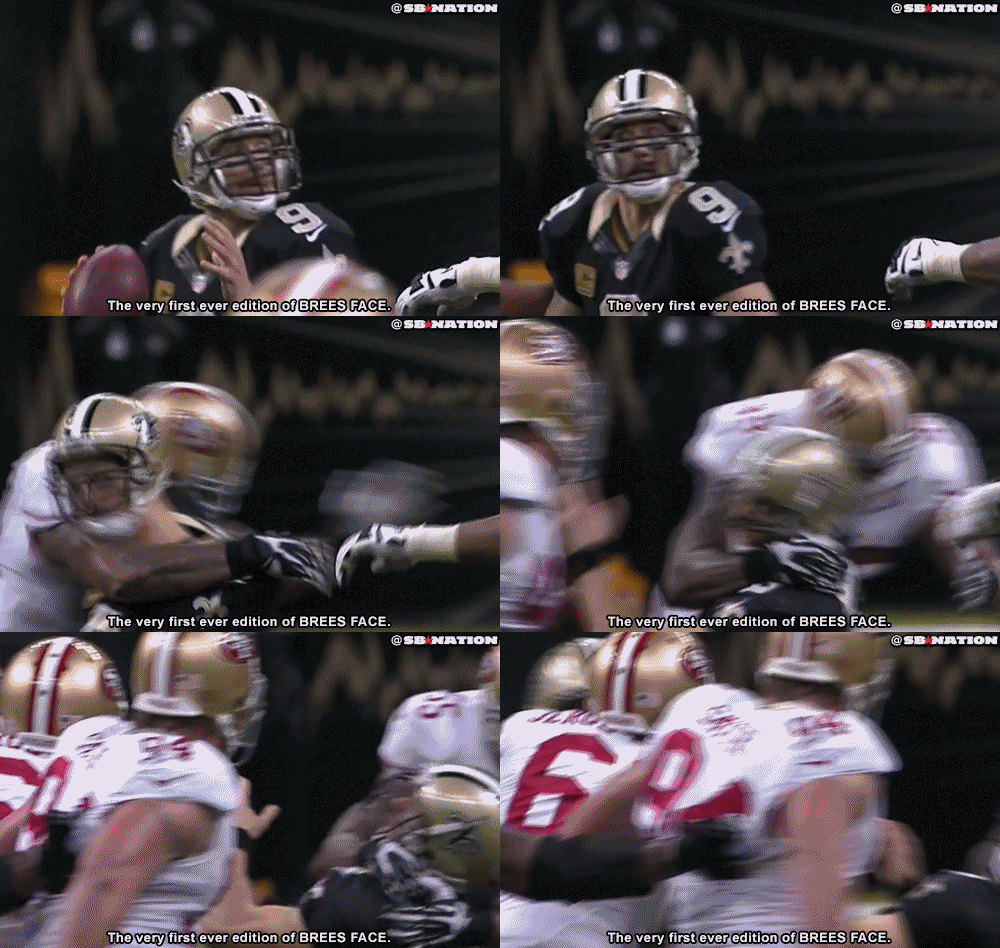
"He will definitely need some Nyquil tonight!" -my fianceeE.H. Ruddock wrote:
if thats the point of the rule you shouldnt be allowed to hit qb's at all.BurtReynolds wrote:I think any hit to Drew Brees should be illegal. Would be devastating to see Luke McCown enter the game.
yeah that one was worse. both were terrible, of course, but at least the brooks hit looked bad.Fuzzy_Dunlop wrote:If you think that's a bad roughing the passer call on Brees check this one. Where exactly are you supposed to hit this guy?
http://larrybrownsports.com/football/je ... gif/209557