Re: PRAMG Top 10
Posted: Fri March 01, 2024 6:32 pm
And Jorge is right about Avocado lol.
Shit, that should have made my list.Ello Sailor wrote:Nice to see so many Quick Escapists.
Devastated to see Trag and Veggie still think The Fixer is good.
indeed, within the PRAMG scrolls, one will find discussion that it was in spirit a post-Riot act 'popularity-grab'Jorge wrote:PRAMG isn't even entirely about the music (even though I think S/T sucks ass). It's more about the sharp and sudden change in their business and marketing decisions, which happened to coincide with their turn to more accessible music

This is all valid, and also I think Mike expressed in an interview the feeling of looking around at the music scene around the time of Riot Act and feeling adrift, like they were being left behindMs Harmless wrote:I think my first "wait what??" was the Verizon deal during S/T; that's not to say there was nothing before that (and I find Stip's argument that it began at Yield very compelling), but I'd really "come of age" and was well into my 20s when S/T came out, so the commercial choices they made (or maybe just lazily sat by while other people made on their behalf) became a tougher pill to swallow
in 2024, I think there are various factors that I've come to terms with, including but not limited to
- they've got older, of course, and no longer feel they need to prove anything; they want to find the sweet spot between enjoying their music, and delegating on everything else (which, conversely, can at times give the impression they phoned in the music)
- I'm convinced Ed has / had trauma from Roskilde; he processed it closely on Riot Act; then Pearl Jam was reborn, a new band whether we like it or not; they didn't want to be a band that started moshpits anymore, in multiple ways; I think of the fact that Ed laughed at old footage of himself when he went on Jools Holland (not an amused laugh, a pained, embarrassed... take it away from me laugh), and the music he made increasingly being about how we don't have much time left, so we have to love, now, before we're gone
- this all seemed to result in a band who "fought to get it back again" because life is too short to keep sabotaging our career anymore
I think that over the years I've grown both apathetic to, and accepting of, the things I haven't loved about the PRAMG, and also in my empathy; I might not like what happened but I know (as a traumatised person myself) that there's a pre-trauma me, and a post-trauma me, and however much I'd like to reach back and salvage whatever cool bits I can find about pre-trauma me, it ain't gonna happen; I go forward as I am and as things are, or I stop; Pearl Jam decided not to stop, so we got Pearl Jam 2.0
for sureJorge wrote:This is all valid, and also I think Mike expressed in an interview the feeling of looking around at the music scene around the time of Riot Act and feeling adrift, like they were being left behindMs Harmless wrote:I think my first "wait what??" was the Verizon deal during S/T; that's not to say there was nothing before that (and I find Stip's argument that it began at Yield very compelling), but I'd really "come of age" and was well into my 20s when S/T came out, so the commercial choices they made (or maybe just lazily sat by while other people made on their behalf) became a tougher pill to swallow
in 2024, I think there are various factors that I've come to terms with, including but not limited to
- they've got older, of course, and no longer feel they need to prove anything; they want to find the sweet spot between enjoying their music, and delegating on everything else (which, conversely, can at times give the impression they phoned in the music)
- I'm convinced Ed has / had trauma from Roskilde; he processed it closely on Riot Act; then Pearl Jam was reborn, a new band whether we like it or not; they didn't want to be a band that started moshpits anymore, in multiple ways; I think of the fact that Ed laughed at old footage of himself when he went on Jools Holland (not an amused laugh, a pained, embarrassed... take it away from me laugh), and the music he made increasingly being about how we don't have much time left, so we have to love, now, before we're gone
- this all seemed to result in a band who "fought to get it back again" because life is too short to keep sabotaging our career anymore
I think that over the years I've grown both apathetic to, and accepting of, the things I haven't loved about the PRAMG, and also in my empathy; I might not like what happened but I know (as a traumatised person myself) that there's a pre-trauma me, and a post-trauma me, and however much I'd like to reach back and salvage whatever cool bits I can find about pre-trauma me, it ain't gonna happen; I go forward as I am and as things are, or I stop; Pearl Jam decided not to stop, so we got Pearl Jam 2.0
This is moving 100% into speculative territory, but the way in which they framed their "return" with S/T made me wonder if they had U2 on the brain. In the years before Avocado, U2 tried a similar tack, with All That You Can't Leave Behind being the "we're back" album after a run of, once again, weird art records in Zooropa and Pop (I'm not saying that was the intent of those albums, but it seemed like they were taken as U2 moving away from what they were supposedly good at).Thurman Murman wrote:Anecdotally it fits though. I have two close friends that grew up loving Ten-Vitalogy era Pearl Jam with me but fell off with No Code. In both cases they came back to the band with the S/T album.digster wrote: The whole idea behind S/T's marketing push is "we're rocking again, we're not going to make weird art records anymore" - which is just kind of marketing gobbledygook, as Binaural and Riot Act aren't really anywhere near the extreme of being weird art records. And it doesn't really matter, as long as the results are good, and while I may think S/T is a step down from the previous records, it's still a good record in hindsight. But being around during the push of that record, it was just clearly a different approach then they'd taken before.
For better or worse S/T will always be the "return to form" album in my mind.
More true than most admit.stip wrote:I think it's one reason why, consciously or not, so many of us feel relieved that they can still recapture some of that energy from their youth, filtered through experience. It means we can too.
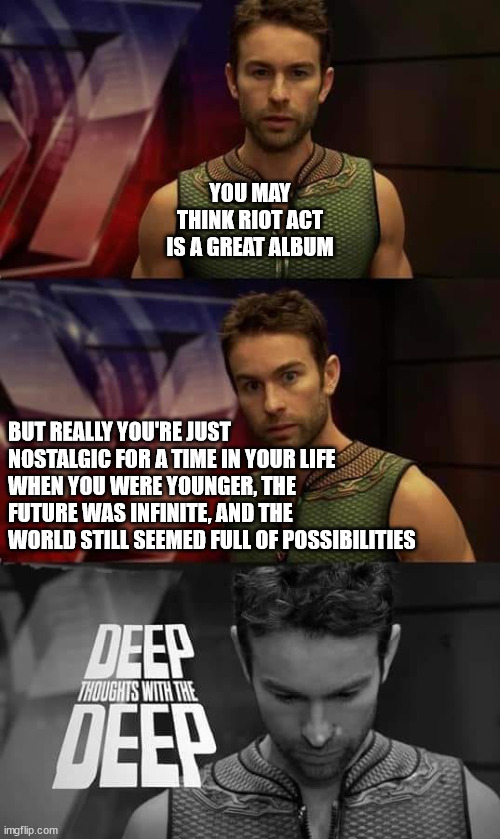
This wouldn't shock me either. I suspect you're right, actually. But in the end Pearl Jam is not going to want to put in the kind of work required to be a band like U2. It's not being lazy. It's just not who they aredigster wrote:This is moving 100% into speculative territory, but the way in which they framed their "return" with S/T made me wonder if they had U2 on the brain. In the years before Avocado, U2 tried a similar tack, with All That You Can't Leave Behind being the "we're back" album after a run of, once again, weird art records in Zooropa and Pop (I'm not saying that was the intent of those albums, but it seemed like they were taken as U2 moving away from what they were supposedly good at).Thurman Murman wrote:Anecdotally it fits though. I have two close friends that grew up loving Ten-Vitalogy era Pearl Jam with me but fell off with No Code. In both cases they came back to the band with the S/T album.digster wrote: The whole idea behind S/T's marketing push is "we're rocking again, we're not going to make weird art records anymore" - which is just kind of marketing gobbledygook, as Binaural and Riot Act aren't really anywhere near the extreme of being weird art records. And it doesn't really matter, as long as the results are good, and while I may think S/T is a step down from the previous records, it's still a good record in hindsight. But being around during the push of that record, it was just clearly a different approach then they'd taken before.
For better or worse S/T will always be the "return to form" album in my mind.
I wonder if PJ started wondering why that couldn't be their career path also (in retrospect, I'm not sure that was ever in the cards because PJ is just an innately different band than U2, particularly in how they project themselves).
I wonder what the correlation is between merch and the decline of record sale revenue. I imagine pretty highKevin Davis wrote:The shift in 1998 really just brought PJ back to the standard observed by all other bands of their profile at the time. So it felt like a big about-face for them relative to the exceptional circumstances they had created in the years just prior, but not necessarily something that felt weird in general, especially since a lot of it came with a sort of mea culpa to the effect of, “Hey, we tried this, we thought we were saving you money, but we realize that mostly we were just making it harder for you to see us live and find out what we were up to.” Same with the official bootlegs: “We see that people are charging $40 for bad recordings of our concerts; we can do this right and charge you $15 for good recordings of them.” Classic win-win.
To me the PRAMG concept rests entirely on the decrease in new creative work, coupled with a seeming increase in effort to sell other things, many of them nonmusical and some of them pretty silly. When a band is creatively engaged, that marketing feels like part of the churn that keeps the whole thing going. When they’re not, but the rest of it continues anyway, it calls attention to the missing ingredient.
The fact that the PRAMG era dovetails perfectly with the rise of social media is no doubt a huge part of why some people register this the way they do. And it is overwhelmingly not a phenomenon unique to PJ.
this little playlist is pretty dang good, even if I do say so myselfMs Harmless wrote:in order of album release, not preference:
Life Wasted
Unemployable
Amongst the Waves
Speed of Sound
Sirens
Pendulum
Swallowed Whole
Whoever Said
Dance of the Clairvoyants
7 0'Clock
River Cross (for free)