Re: Women's Health Issues
Posted: Mon June 27, 2022 5:15 pm
Also verb, pretty sure the majority of anti abortion people in the US are willing to align with any Muslim to make their point
It just seems like you’re pretty willing to dismiss this as a white guy from 1800s thing when In fact there are a variety of demographics who identify as pro choice. I wonder why people are only willing to single out one specific group? That doesn’t seem fair.E.H. Ruddock wrote:They may be. I don’t know. But I’m talking about the majority in the US. I’m trying to ask questions here, admitting that it may be naive. Why are you trying to “gotcha” me here? Must you always be a giant douche?
My original question was because the SC basically said nowhere in the constitution does it protect abortion rights, at least that is how I interpreted it. That brought me to the broader though of who wrote the constitution, based on the demographics of our country then vs. now. Back then the white men that wrote it all basically subscribed to "men govern, women cook and give us kids". Today, that is not the case. But the SC is referring back to the constitution. My question was a hypothetical and admittedly naive. Clearly I'm not as smart as a lot of people in here, you apparently included, with your non-racist, non sexist posts you've been known for.verb_to_trust wrote:It just seems like you’re pretty willing to dismiss this as a white guy from 1800s thing when In fact there are a variety of demographics who identify as pro choice. I wonder why people are only willing to single out one specific group? That doesn’t seem fair.E.H. Ruddock wrote:They may be. I don’t know. But I’m talking about the majority in the US. I’m trying to ask questions here, admitting that it may be naive. Why are you trying to “gotcha” me here? Must you always be a giant douche?
epilogue wrote:"I ask no favor for my sex. All I ask of our brethren is that they take their feet off our necks,"Bi_3 wrote:BurtReynolds wrote: Granting them special powers?
*Affected, and not even remotely true.Bi_3 wrote:It's worth noting that the majority of the effected demographic still has the same access that had before the decision.
Women weren’t blue haired back then I’m sure they were mostly fine with the constitutionE.H. Ruddock wrote:My original question was because the SC basically said nowhere in the constitution does it protect abortion rights, at least that is how I interpreted it. That brought me to the broader though of who wrote the constitution, based on the demographics of our country then vs. now. Back then the white men that wrote it all basically subscribed to "men govern, women cook and give us kids". Today, that is not the case. But the SC is referring back to the constitution. My question was a hypothetical and admittedly naive. Clearly I'm not as smart as a lot of people in here, you apparently included, with your non-racist, non sexist posts you've been known for.verb_to_trust wrote:It just seems like you’re pretty willing to dismiss this as a white guy from 1800s thing when In fact there are a variety of demographics who identify as pro choice. I wonder why people are only willing to single out one specific group? That doesn’t seem fair.E.H. Ruddock wrote:They may be. I don’t know. But I’m talking about the majority in the US. I’m trying to ask questions here, admitting that it may be naive. Why are you trying to “gotcha” me here? Must you always be a giant douche?
I wish we were more like European countries!Mickey wrote:*Affected, and not even remotely true.Bi_3 wrote:It's worth noting that the majority of the effected demographic still has the same access that had before the decision.
Thanks. This is the superior intelligence answer I was hoping for.verb_to_trust wrote:Women weren’t blue haired back then I’m sure they were mostly fine with the constitutionE.H. Ruddock wrote:My original question was because the SC basically said nowhere in the constitution does it protect abortion rights, at least that is how I interpreted it. That brought me to the broader though of who wrote the constitution, based on the demographics of our country then vs. now. Back then the white men that wrote it all basically subscribed to "men govern, women cook and give us kids". Today, that is not the case. But the SC is referring back to the constitution. My question was a hypothetical and admittedly naive. Clearly I'm not as smart as a lot of people in here, you apparently included, with your non-racist, non sexist posts you've been known for.verb_to_trust wrote:It just seems like you’re pretty willing to dismiss this as a white guy from 1800s thing when In fact there are a variety of demographics who identify as pro choice. I wonder why people are only willing to single out one specific group? That doesn’t seem fair.E.H. Ruddock wrote:They may be. I don’t know. But I’m talking about the majority in the US. I’m trying to ask questions here, admitting that it may be naive. Why are you trying to “gotcha” me here? Must you always be a giant douche?
I’m fairly comfortable assuming next to nobody agreed with the progressive policies of today in 1800. Hand wringing about oppression doesn’t make sense in the context Ruddo is trying to spin.Mickey wrote:Oh well if you're sure.
Show me.Mickey wrote:*Affected, and not even remotely true.Bi_3 wrote:It's worth noting that the majority of the effected demographic still has the same access that had before the decision.
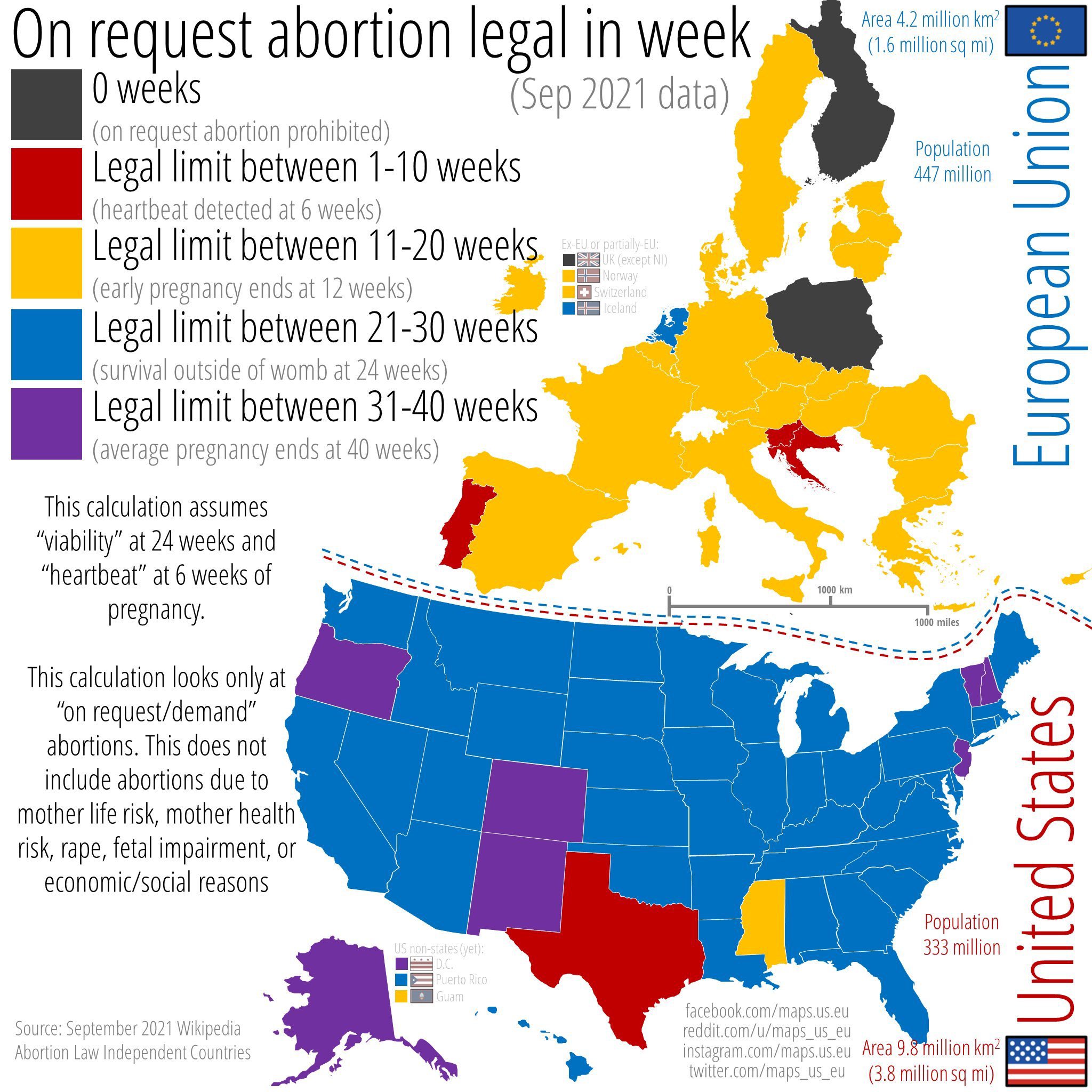
I'm not sure how EU to US in this context is at all a fair or worthwhile comp.Bi_3 wrote:Now, lets just breathe, sit and think for a minute about the rest of human civilization. Limit it to Europe if you are more comfortable there. The US was an outlier in terms of abortion laws with the Casey standard of viability. By revoking that alongside Roe we haven't fallen into Gilead, we've just delegated it back to state level governments like is done in the EU:
Clarence Thomas has made it impossible. Can’t you see!?Bi_3 wrote:Show me.Mickey wrote:*Affected, and not even remotely true.Bi_3 wrote:It's worth noting that the majority of the effected demographic still has the same access that had before the decision.
It's possible states (Florida, Georgia, Ohio, Pennsylvania, etc.) could move to modify existing laws but that is not what I said.
It’s fair when you need to be. But I get it, not this timeepilogue wrote:I'm not sure how EU to US in this context is at all a fair or worthwhile comp.Bi_3 wrote:Now, lets just breathe, sit and think for a minute about the rest of human civilization. Limit it to Europe if you are more comfortable there. The US was an outlier in terms of abortion laws with the Casey standard of viability. By revoking that alongside Roe we haven't fallen into Gilead, we've just delegated it back to state level governments like is done in the EU:
One fucking google my man:Bi_3 wrote:Show me.Mickey wrote:*Affected, and not even remotely true.Bi_3 wrote:It's worth noting that the majority of the effected demographic still has the same access that had before the decision.
It's possible states (Florida, Georgia, Ohio, Pennsylvania, etc.) could move to modify existing laws but that is not what I said.
https://www.vox.com/2022/6/25/23182753/ ... igger-lawsThree states — Kentucky, Louisiana, and South Dakota — had statutes already on the books that allowed for complete or near-complete bans on abortion to take effect immediately following the Supreme Court’s overturning of Roe v. Wade. None of these states make an exception for abortion in cases of rape or incest. Six other states with trigger laws have also had their complete or near-complete bans on abortion swiftly implemented. There are a total of 13 states with trigger laws, though their scopes vary and so do their implementation.
In Alabama, a judge lifted an injunction on Friday that allowed the state’s 2019 law banning abortion to become legal. In Arkansas, Missouri, and Oklahoma, the trigger laws became active after the Supreme Court’s decision was certified by the respective states’ attorneys general. Many Republican officials hailed the Supreme Court’s decision as a celebratory milestone for so-called pro-life conservatives. Missouri Attorney General Eric Schmitt, who was the first AG to sign such a certification in the wake of the Dobbs ruling, rejoiced in the opportunity.
“My office has been fighting to uphold the sanctity of life since I became attorney general, culminating in today’s momentous court ruling and attorney general opinion,” Schmitt said in a statement. “I will continue the fight to protect all life, born and unborn.”
Complete or near-complete abortion bans in other trigger law states are expected to take effect within a certain period (typically within 30 days) after actions from state officials. Mississippi, another trigger law state where the court’s decision needs to be certified by the attorney general, has a shorter grace period, with its law taking effect just 10 days after certification. In North Dakota, anti-abortion laws will take effect immediately after the state’s attorney general signs off on it. North Dakota AG Drew Wrigley has 30 days to do so but said his office is reviewing the Dobbs decision. In Tennessee, anti-abortion laws will take effect 30 days after the court’s decision, with the lone exception being the risk of death or permanent disability.
Idaho’s trigger law will kick in 30 days after the court’s official opinion is published — which is expected in about a month — enacting a near-complete ban on abortion in the state with the exceptions of cases of medical emergencies, rape, and incest. Texas’s trigger law will take effect 30 days after the court issues a judgment, not just an opinion. Texas Attorney General Ken Paxton clarified that the official judgment should be issued after an appropriate period in which any appeals can be filed. The state already had a law banning abortions after six weeks except to save the life of the pregnant person, which took effect in September 2021.
Wyoming and Utah are also trigger law states with anti-abortion legislation ready to be reactivated. Wyoming’s trigger law will take effect five days after the court decision is certified by the state’s governor, Mark Gordon, who described the Supreme Court’s Dobbs ruling as “a decisive win for those who have fought for the rights of the unborn for the past 50 years.” In Utah, the trigger law took effect after court decision was certified by the state’s legislative general counsel, which occurred the same day as the Dobbs ruling. Utah’s law will ban nearly all abortions except in cases of rape and incest, but only if reported to law enforcement. Utah’s law also allows exceptions in cases in which a baby would have severe birth defects and if a pregnancy puts the individual’s life at risk.
Show me when I've ever said I needed it to be.verb_to_trust wrote:It’s fair when you need to be. But I get it, not this timeepilogue wrote:I'm not sure how EU to US in this context is at all a fair or worthwhile comp.Bi_3 wrote:Now, lets just breathe, sit and think for a minute about the rest of human civilization. Limit it to Europe if you are more comfortable there. The US was an outlier in terms of abortion laws with the Casey standard of viability. By revoking that alongside Roe we haven't fallen into Gilead, we've just delegated it back to state level governments like is done in the EU: